Tuesday, July 27, 2010

Arcade Fire - The Suburbs


With each album, the Arcade Fire have made a singular theme the focus of their work. On their 2004 debut, Funeral, loss was the nucleus of the album, hence the album's title. The loss came in many forms, whether it was death, loss of childhood innocence or loss of memory.

On 2007's Neon Bible, the Arcade Fire made the right wing Bush-era their target, and at one point front-man Win Butler even screamed "I don't want to love in America no more". And since the band hails from Montreal, Quebec, the Houston native Butler brothers -- as well as the rest of the band -- mean what they say.

Now the year is 2010. Barack Obama is in office -- someone that the Arcade Fire relentlessly supported during Obama's run for the presidency. So without a singular enemy to focus their angst upon, the band has aimed their sights at the suburbs. Hence, their third album's title.

The Suburbs is easily the band's most focused work. The songs build upon one another, Butler even repeats lyrics from earlier songs in later ones, driving the message home: the Arcade Fire hate the never ending sprawl of the suburbs and the loss of identity that comes with it. I hate it too...even though I live smack dab in the middle of the suburbs myself. Thankfully, my neck of the suburbs aren't crammed with "dead shopping malls rising like mountains beyond mountains", as Regine Chassagne points out on the albums best track, "Sprawl II (Mountains Beyond Mountains)".

So what does it all mean? I don't think Butler and the band have much of an idea about it either as evidenced in many of the lyrics featuring self doubt. On the opener,"The Suburbs", Win admits "sometimes I can't believe it/I'm moving past the feeling, again". I take that as Butler realizing he's getting comfortable as he gets older, and losing that rebellious fire we all had as teenagers and college students before the real world turned us all into zombies. And on "City With No Children", Butler riffs on millionaires and how they can't be trusted, but then laments that he feels himself becoming one of them himself. And in the final minute of the album, on "The Suburbs Continued" Butler admits "if I had it all back, I'd waste it again".

But most of The Surburbs is made up of the wasted hours of teenagers, late-night drives, and kids who are mad at the world for no reason. It all paints the picture of a man who is coming to see beneath the surface of his life, hates what he sees, but doesn't do anything to change it. We all sell out little by little, we all become the adults we rebelled against as kids, and The Suburbs so accurately nails this, time and time again.

Like the band's focus on their main theme, this album is the band's most sonically focused album yet. Sometimes it's a little too focused, and I miss the band's natural ability to come apart at the seams, to color outside the lines a bit and add some fuzz to their sound. Not here. Every note is measured. There is more of a electronic feel to the sound. The band sounds like it's a four or five piece at times, not the expansive seven piece it's been until now. And while it works at times, it also causes the band to lose some of things that made it so great. There are no impromptu choral singalongs like on"Wake Up" or "No Cars Go". The band has grown up a bit, moved to the musical suburbs themselves, and ditched some of the unpredictable characteristics that made their first two albums so amazingly fresh.

That isn't to say The Suburbs isn't fresh or amazing. It's so good it's heartbreaking. It's the band's most measured album to date. An instant classic that will stand on its own well into the future. And I can say that after only having listened to the album a few times through.

Sometimes it takes a while to realize greatness, and for me that was Radiohead's Kid A, which took me almost 10 years to appreciate. But with the Arcade Fire, I have always known, right from the start, that the band and their music are something special.

The Suburbs is no different.

Tuesday, May 25, 2010

The end of an era

Lost began airing in 2004.

24 began airing in 2001.

Two nights. Two finales. And the end of what I call the Golden Age of Modern Television.

It all began around 1999 with the launch of HBO's The Sopranos. Sure, there had been some shows that had pushed the boundaries of censorship on television before (NYPD Blue, which began airing in 1993, comes to mind), but on HBO, The Sopranos were able to do pretty much anything that any R-rated movie could do, and they could do it on TV. And other HBO shows such as The Wire, Rome and True Blood carried on that ability.

And that same "push the envelope" style eventually trickled down to network dramas, such as The Shield (FX), Alias (ABC) as well as Lost and 24. Granted, these shows were on the major networks, so what they could get away with paled in comparison to shows on HBO. But in the end, shows like 24 and Lost pushed the boundaries of what could be done in the hour-long format on television. I mean, the last few episodes of 24 included a disembowelment, a skewering, various head-shots, and a bitten-off ear!

What 24 and Lost represented was viewer commitment. These weren't shows that you could drop in and out of. They demanded consistent loyalty and viewership, or you could find yourself asking "what the hell is going on?" This was especially true of Lost, which routinely puzzled its viewers with elaborate mysteries week after week. Sometimes, just watching each episode of Lost wasn't enough, you needed to research each episode on websites like Lostpedia or on chat rooms and message boards to discuss different theories to stay up to speed.

But the demand for viewer loyalty is where the similarities of these shows ended. At their core, the Lost and 24 couldn't be any more different.

24, which took place in "real time", was all action and adventure; with an endless barrage of double-crosses, major character deaths, and races against the clock to prevent national terrorist attacks.

Lost, on the other hand, dealt with a much more weighty issues: faith, fate vs free will, religion, and redemption. It also relied heavily on symbolism and allusion, referring to numerous books, movies, and other forms of art to entice the viewer and prompt discussion. If the water cooler discussion for 24 usually involved "I can't believe Jack did that last night!", the discussion for Lost was more like a college seminar on mythology and literature, and each discussion could last just as long. And the Lost 101 professor was Jeff "Doc" Jensen, a TV reporter for Entertainment Weekly, who gained fame for his extensive Lost re-cap articles, in which he broke down pretty much every scene of each episode and pontificated aloud for a dozen or so pages every week. The same just couldn't be done for 24 unless it included obituaries for each of the characters killed every week.

That isn't to say that its deep subject matter made Lost better than 24. It's a matter of opinion as to which show you prefer: the breezy, break-neck speed of 24 or the slow-burn novelistic approach to Lost.

What I use to judge the shows is this: How much did I look forward to watching each show? With Lost, I was excited to watch each episode -- from the pilot to the finale -- and then read Jensen's article in EW. With 24, I caught the first three seasons on DVD, and found myself saying "just one more episode" after I had already watched three in a row. But in the end, I felt that 24 couldn't sustain its format. After eight seasons, it seemed like the writers employed the same plot twists each season, with the characters and situations just changed. The "real time" format, which was originally a nifty story-telling device, became redundant, and unrealistic. Characters would routinely be shot, stabbed, have heart attacks or who knows what else, only to be up and about in the next episode, which was less than an hour's time.

And because of this, 24 became somewhat of a chore.

Lost, for me, never felt that way. Sure, there were times when Lost could test your patience (I feel the same about The Sopranos), but that what was so great about it -- its ability to drive you mad with anticipation for an answer to one of its many mysteries: What's in the Hatch? Who are The Others? Who is Jacob? What is the Smoke Monster? What is the island? And by series end, we learned the answer to just about every major mystery, without those answers being spoon-fed to the audience to the point where multiple viewings of Lost become useless. If anything, a repeat viewing of the entire series will be more rewarding than the first, since you know how it all ends and won't be demanding answers.

Unlike Lost, however, the 24 franchise is not over. If the 24 series finale told us anything, it's that there is much more to come. The finale of 24 kept Jack on the run from the authorities and basically left things open-ended for movies, which have been in the works for years. With Lost, the writers were clear, this was definitely "The End". I do think there is an opportunity for a series of Lost inspired books or comic books to spin-off and fill in some of the unanswered questions, but I think the canon of the series is definitely over. And I am glad. There was no more a fitting ending than what was presented last Sunday night. When I think about it, I still get the shivers.

With 24, I expect there to be many more double-crosses, character deaths, and pulse-pounding action sequences for years to come. And I look forward to see that happen on the big screen. I just hope the move to the big-screen gives the franchise a much-needed breath of fresh air.

Actually, it's ironic that 24 is going to the movies. It was 24, and other "boundary-pushers" like it that made me stay at home, and watch a few episodes instead of going out to the movies. The reward with television shows has always been greater, and most of the time, they're free.

In the end, both the 24 and Lost series finales closed the door to what was, without a doubt, the best decade for television, ever. They were often imitated, but never duplicated, and they both leave massive voids for the major networks to fill.

And I doubt they ever will be.

Tuesday, March 23, 2010

Seeing Red

The proposed route for Baltimore's Red Line. Click here for a bigger picture.

I like to use public transportation. I like the freedom of leaving my car at home or in a parking lot far from the hectic downtown area and taking a train or bus into a city and roaming its streets, hopping on and off the train, and soaking up everything a city has to offer. This is largely why I love traveling to Europe, where you can get around major cities with ease. Most European cities have comprehensive subway systems, street trams, and buses that are easily laid out, cheap and simple to use. And getting from city to city in Europe is also cheap and easy, compared to America where Amtrak has a monopoly and can charge expensive prices for tickets.

So it sucks for me that I live in Baltimore, where the mass transit options are limited. Even worse, there seems to be a bias against mass transit in Baltimore. People here in Maryland love their cars, which explains why Maryland is currently the fifth worst state for traffic gridlock in America according to UrbanTrekker. The light rail is commonly referred to as the "loot rail" and it seems like the local bus has been left to the bottom rung of society according to the middle class.

That said, the light rail and subway are crowded on Sundays when the Ravens are in town. If the light rail does one thing well, it ushers thousands of fans to M&T Bank Stadium with ease. But during weekdays, ridership drops to 34,000 a day. The subway has 57,000 riders a day, making the total ridership of rail-based mass transit in Baltimore approximately 91,000 for a city with 600,000 residents and a metro area of more than 2.6 million people, meaning that only 3% of the Baltimore metro population regularly uses rail-based mass transit in Baltimore.

The Maryland Mass Transit Bias (I shall dub this the MMTB) is probably the biggest reason for the low ridership, but there are other factors to consider as well. The light rail only serves suburbs north and southwest the city leaving the entire eastern side of Baltimore County without a rail-based line to get downtown. The subway serves only the upper-west side of Baltimore County (Owings Mills), and terminates at Johns Hopkins University, which is centrally located in Baltimore. If the subway continued east down the Route 40 corridor to Rosedale or Essex, it would open a much needed line to and from the east side of the city.

Another inconvenience: the light rail makes frequent stops as it travels through the downtown area of Baltimore. And although traffic lights are programmed to turn red for the train as it gets close, riders can still wait at traffic lights on the light rail as if they were sitting in their car. After Ravens games, I've seen traffic police holding up trains while cars and pedestrians cross over Howard Street. This is unacceptable. The common rule of thumb is for mass transit to have right of way over everything -- especially cars. This is just another reminder of where mass transit is in the Baltimore pecking order.

And while the subway doesn't have to deal with the city traffic, it does suffer from long waits between trains on weekends. On weekdays it looks like both the light rail and the subway run on 10-15 minute schedules, which is common for a city the size of Baltimore. It would be nice to see the city recognize the increased demand for trains after major sporting events, however. Waits for subway and light rail trains can take longer than 20 minutes.

All of this brings me to the meaning of this article (sorry for taking so long to get to it) -- the Red Line. The Red Line is a proposed east-west light rail track that starts at Security Square Mall on the west side of the city and runs through the city on the Route 40 corridor, including the center median on the infamous "Road to Nowhere" -- a section of Route 70 that was built before the extension of Route 70 to I-95 near Caton Avenue was halted back in the early 1980's. The Red Line would then travel underground through downtown Baltimore and return to street level as it traveled through Fells Point and Canton where it would either terminate in Canton or continue east to Dundalk.

In short, the Red Line would bring Baltimore mass transit options up to where it should be for a city this size. It would give residents who live west of the city in Howard and Carroll Counties a way to get downtown via a station at the Route 70 park and ride and open that much needed line to the east side of Baltimore County.

Right now, I use the light rail for Ravens and Oriole games. If the Red Line were built, I would be able to drive down from New Market on Route 70, park at the lot at the end of the highway (where the current park and ride lot is located) and hop onto a train for easy access to the downtown area. I'd never have to get off Route 70. And neither would many other people who come down the Route 70 corridor for Ravens games or work, which would go a long way in alleviating traffic on the congested 695 Beltway.

The problem is this: people don't want the Red Line built, namely people in Edmonson Village and Canton, who don't want a train running through their neighborhoods. These people are referred to as NIMBY's (Not In My Back Yard), and they are the biggest obstacle in getting most mass transit lines built, whether in Baltimore or Budapest. As with most mass transit opposition, crime, noise and inconvenience are the biggest concerns.

According to the Red Line's Facebook page, the Red Line would bring 10,000 jobs to Baltimore. There is also a link to a short video about Seattle's most recent light rail line, and how it's been a major part of helping the redevelopment of some of the city's isolated neighborhoods. This is commonly referred to as "Smart Growth", connecting isolated communities to the downtown area and building new communities around mass transit stations. Common examples of Smart Growth are only a short ride from Baltimore, in Bethesda, MD and Rosslyn, VA. Yet in Baltimore, Smart Growth is mocked and shunned while mass transit is commonly linked to crime and the decline of neighborhoods.

The link between crime and mass transit is commonly used by detractors of mass transit, but never officially proven. And in the cases of Edmonson Village and Canton, neighborhoods where crime is the number one reason against the Red Line, mass transit already exists -- it's called the local bus.

So ironically, the Red Line has gotten caught up in red tape. With the economic downturn, the Red Line has been put on the back burner for the time being, along with other civic improvement plans, such as a new arena. It's disappointing, really, to see a city fail to take advantage of options and strategies that could transform it into something better. It costs money, sure, but the long-term payoff is always worth it.

In the meantime, I'll cross my fingers and hope that some real progress on the Red Line takes place. Until then, this fan of public transit is seeing red.

Monday, March 22, 2010

Christian Bale -- Good Actor?

I am ripped, yes, but I am not that good of an actor.

Do you consider Christian Bale a good actor? I don't.

Sure, he's in good movies, but think about some of the recent movies he's been in...and how poor his performance has been in them.

I watched Public Enemies last night, and I really enjoyed it. Johnny Depp was good as John Dillenger, and Tommy from Snatch was a great Baby Face Nelson. But Bale as Depp's foil was just "meh". His 1930's era Chicago accent was bad. Come to think of it, Bale has several problems with his voice in movies.

In Batman Begins and The Dark Knight, his grumbly Batman voice was horrible...even fans who loved those movies were critical of Bale's voice. In Terminator Salvation, again he went for a gruff voice which came off as monotone, and ultimately lead to many people criticizing his flat performance. And in Enemies, his voice sounded like Fred Armisen impersonating Barack Obama on Saturday Night Live.

Bale does have a knack for picking solid scripts and working with established directors. Chances are, when Bale is in a movie, it's going to be good, which is why many fans hopes were raised when he joined Terminator Salvation. But Bale's participation in Salvation was an ego-trip. He signed on to play John Connor, who originally had a three-minute role at the end of the film. So Bale demanded the role be fleshed out, and it was, ultimately rendering the Connor part of the film irrelevant compared to the role of Marcus (Sam Worthington), which was the driving narrative force behind Salvation.

Bale is often shown up by other actors in the same movie, too. In The Dark Knight it was Heath Ledger. In 3:10 to Yuma it was Russell Crowe (although Ben Foster upstaged them both). In Terminator Salvation it was Sam Worthington and Anton Yelchin. And in Public Enemies it was Johnny Depp and Tommy from Snatch. This happens so often because Bale is a one-note actor and can't breathe any depth into his roles.

To be fair, Bale has done some good work as an actor. His performance in American Psycho was both dark and humorous. Bale's flatness actually worked in that role. And in Rescue Dawn, Bale did a wonderful job portraying a POW who escapes captivity and makes a run for it in the harsh jungles of Vietnam, all while on the verge of suffering a mental breakdown. It's probably Bale's best performance in a career of mediocrity. Bale is also known for taking on physically demanding roles. In The Machinist he lost 80 pounds and shed lots of weight for Rescue Dawn. He's also put on weight and gotten ripped for other roles.

So what is it about Christian Bale that gets people excited? Surely it's not his acting ability. It's his good decisions. When Bale is in a movie, chances are, it's going to be good. Also, being a good looking guy with rigid features doesn't hurt.

So I, as well as millions of other moviegoers, will still continue to see Christian Bale on the big screen. And despite his obvious lack of acting ability, I still consider him a good actor because he chooses good scripts and occasionally turns in a good performance.

Friday, March 5, 2010

The biggest rivalry going today...

Yankees & Red Sox?

Nope.

Duke & UNC?

Wrong.

Ravens & Steelers?

Think again.

Republicans & Democrats?

DING! DING! DING!

I love it when people criticize sports fans. They say "you're cheering for spoiled athletes who make millions". And when you think about it, being a devoted sports fan is kind of funny. You're basing your happiness or despair on the accomplishments of others. People you've never met. People who wouldn't give you the time of day if you met them on the street.

But for some reason, political fans get a pass. And if you ask me, political fans are a million times worse than any sports fan. Well, most of them.

Here's why.

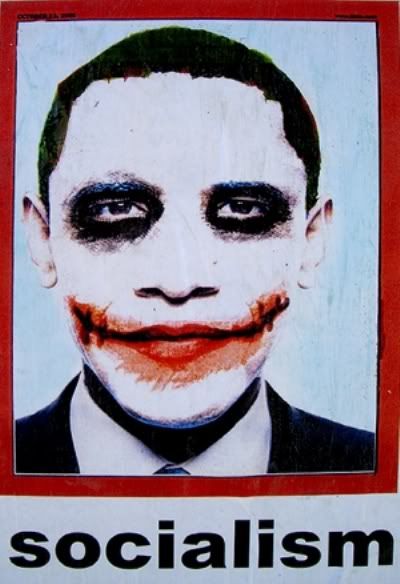
Have you see the Barack Obama picture where he's painted as the Joker? The word "Socialism" is printed beneath the picture.

What is the point of that picture? What does it accomplish?

Nothing!

It's no different than the bumper sticker of Calvin pissing on a Ford logo. Or a Steelers logo. It does nothing but incite hatred and ignorance. It's an avatar for a group of fanatics who feel they must align with one side of the political spectrum. God forbid they try to stay centered, or think for themselves. Nope. If you believe in one ideal, you have to believe in all the others that go along with it. It's like ordering cable. You just want HBO? Too bad. You have to get two dozen other channels you don't care about and you have to pay for them too.

Heading into work today I saw a bumper sticker that read, "Independence Day: 1/20/2013".

It's the day that a Republican president would take office if they won the 2012 election. Maybe you remember the countless stickers saying the same thing about George W. Bush's last day in office. Both sides of the spectrum are guilty of the same hate-mongering. It's just the Republicans turn to spew their venom right now.

And unlike sports, where most athletes and fans can shake hands after a game before going their separate ways, in politics, there is no meeting in the middle. If you believe in something different than one group you're instantly labeled a communist, socialist, right-wing nutjob -- or my favorite -- un-American.

WTF is "un-American" anyway? What is "American" in the first place?

Listen to the talk shows. The hosts don't just preach to the choir -- they scream and yell at the choir. More flame-fanning. More hate-spewing. Where will it end? Nazi Germany? I don't think we're too far off to be honest.

Back to sports metaphor: The biggest problem with baseball today is that the Red Sox and Yankees are the two most popular teams, and the media has no problem whipping up the frenzied masses who follow these 2 teams. It's as if the media is telling sports fans to pick a side. Are you going to be a Red Sox fan or a Yankees fan? Because if you are a fan of another team, you're just wasting your time.

And it's the same thing with politics, except there are no other teams. You have to choose a side. Don't even think about staying in the middle.

That's why I try to stay out of it.

I'd much rather root for the "spoiled millionaires who cheat on their wives" than throw my support behind a spoiled millionaire who cheats on his wife while telling you not to cheat on your wife.

Thursday, March 4, 2010

Muse @ Baltimore Arena


Am I a Muse fan? Kind of. I prefer the less theatrical Radiohead, of which Muse is endlessly compared. I think of Muse as a Radiohead-meets-Queen stadium band that is mostly good from a distance. Too much of the band at once wears me out. Singer Matt Bellamy's overtly political lyrics can grow tedious at times, and their operatic sound can get cumbersome. However in 2003, I was in love with the band's third album, Absolution, which satisfied my taste for computer space rock before I discovered the more subtle joys of Radiohead.

So when I saw that Muse would be coming to Baltimore's 1st Mariner Arena along with Silversun Pickups on March 3rd, I decided to see them in person. Their style of loud-guitar driven rock would surely sound great live, and Silversun Pickups aren't a shabby opening act either. Plus I wanted to drag my friend Tim to a live show, since his live music experiences usually come from cover bands. It was time to show him what the real thing sounds like.

Silversun Pickups did a breeze forty minute opening set, featuring their better known hits like "Substitution" and "Lazy Eye". They played the fluffer role for the crowd nicely.

But everyone was here to see Muse. And they didn't disappoint.

They kicked off with the song "Uprising" from their newest album, The Resistance, and then segued right into the title track from the album. The band then cherry-picked songs from their last 4 albums, ranging from "Plug-in Baby" from 2001's Origin of Symmetry, "Hysteria" and "Stockholm Syndrome" from 2003's Absolution and "Starlight", "Supermassive Black Hole" and "Knights of Cydonia" from 2006's Black Holes and Revelations.

The stage design was impressive, featuring three "skyscraper" screens that featured video and images throughout the show. There were three small stages in the middle of each skyscraper where a member of the band stood, and they were able to be raised and lowered throughout the show. The laser show was worth the price of admission alone. Best. Lasers. Ever. And another cool stylistic wrinkle were huge eyeball beach balls that were dropped into the crowd. When popped, confetti exploded from them.

The band sounded great, and the sound at the 1st Mariner Arena still compares nicely to other large venues in the area. It's nice to see Baltimore getting some better shows that would usually go to Washington, DC or Philadelphia instead.

I caught the light rail at Nursery Road instead of driving into the city at rush hour and paying $20 for parking in a garage that is notorious for long back-ups after shows let out. Like the arena, the light rail is routinely criticized for not serving the city to its potential, but last night I was very pleased with the entire experience.

Muse rocked the house, and I went home to watch the Maryland/Duke basketball game that I had recorded. Maryland won.

All in all it was the perfect evening.

Tuesday, February 23, 2010

82nd Academy Awards Preview


Believe it or not, the Academy Awards are just a couple of days away. Am I the only one finding it hard to stop writing 2009 on things?

The year seemed to zip by...but not from the amount of quality movies. Overall, I thought 2009 was a weak year for movies, and ironically, the Academy expanded their Best Picture field to 10 movies in a year where they would have been hard pressed to pick 5 movies that really deserved to be nominated.

I do like the decision to nominate 10 films, as it does give acclaim to more commercially successful movies that wouldn't have been nominated had the field still included 5. But, even though there are 10 best picture nominees, there are probably 7 or 8 films that don't stand a chance of winning, making the expansion a moot point.

And let's face it, the move to 10 nominees is about increasing the Oscar TV rating, which have been slumping over the last several years. The Academy is hoping that fans of more commercially successful films such as Avatar, The Blind Side and Up will tune in.

There still were some really good movies in 2009. And most of them were actually nominated for Best Picture. But what I found lacking in 2009 were the amount of standout performances. Only Christoph Waltz from Inglourious Basterds really jumps to mind when I think of great performances of the year. Maybe Mo'Nique from Precious gets in there too. But George Clooney was George Clooney again in Up in the Air. Did he really need to be nominated? Seeing Jeff Bridges nominated for Crazy Heart is cool, since the performance is very close to his performance as The Dude in The Big Lebowski, a role he wrongly wasn't nominated for. But Bridges can play those roles in his sleep by now. And oh yeah, Meryl Streep was nominated for like the 82nd time in a row. Big surprise there!

But enough rambling. Let's take a look at the important categories.

BEST PICTURE

What's nominated (picks in bold represent the movies nominated if the field was still five): Avatar, The Blind Side, District 9, An Education, The Hurt Locker, Inglourious Basterds, Precious, A Serious Man, Up, and Up in the Air.
What should have been nominated: Star Trek lacked the political messages in District 9, but Trek was much more fun. Crazy Heart should have been nominated in place of The Blind Side which was basically an overly sentimental made for TV movie that happened to feature a solid performance by Sandra Bullock. And while the first 15 minutes of Up was on par with the best of any nominee, the second half of the film was your typical Disney goofiness. I would have liked to see (500) Days of Summer or Sugar in its spot.
What will win: Avatar won the Golden Globe and still might be the favorite based on its technical achievements, financial success and treehugging political message, but my money is on The Hurt Locker, which has been gaining steam in recent months thanks to the buzz surrounding director Kathryn Bigelow, who is only the third female director nominated for Best Director.
What should win: I enjoyed The Hurt Locker, but I absolutely loved Quentin Tarantino's Inglourious Basterds. His alternative take on WWII was a funny and suspenseful film that featured the most tense scene of 2009, and possibly, of all time (basement bar scene).

BEST DIRECTOR

Who's Nominated: Kathryn Bigelow, James Cameron, Lee Daniels, Jason Reitman, Quentin Tarantino.
Who Will Win: Kathryn Bigelow. I think the Academy will make a statement (and history) by giving the statue to a female director for the first time ever.
Who Should Win: James Cameron. He created the technology used in Avatar, from performance capture to the next generation 3-D. And while Best Director is not a technical award, Cameron created the world in Avatar, he didn't just hand off the special effects to someone else. His stamp is all over this film.

BEST ACTOR

Who's Nominated: Jeff Bridges, George Clooney, Colin Firth, Morgan Freeman, Jeremy Renner.
Who Will Win: Jeff Bridges with Renner the second horse in this race.
Who Should Win
: Jeff Bridges. His performance gives Crazy Heart its...crazy heart. Yeah, I just said that.

BEST ACTRESS

Who's Nominated: Sandra Bullock, Helen Mirren, Carey Mulligan, Gabourey Sidibe, Maryl Streep.
Who Will Win: Sandra Bullock. It was a good performance by an actress who has been the same in pretty much ever role she's ever had and made a ton of money in 2009. She's the hot pick.
Who Should Win: Gabourey Sidibe. Her performance in Precious was raw, heartbreaking and uplifting all at once.

BEST SUPPORTING ACTOR

Who's Nominated: Matt Damon, Woody Harrelson, Christopher Plummer, Stanley Tucci, Christoph Waltz.
Who Will Win: Christoph Waltz. He was the one standout performance of the year.
Who Should Win: Christoph Waltz. He was the one standout performance of the year.

BEST SUPPORTING ACTRESS
Who's Nominated: Penelope Cruz, Vera Farmiga, Maggie Gyllenhaal, Anna Kendrick, Mo'Nique.
Who Will Win: Mo'Nique. Her performance as a despicable inner city mother in Precious is good we can't allow ourselves to sympathize with her when her character finally sees the error of her ways.
Who Should Win: Mo'Nique.

So there you have it. Do you agree with my picks? Let me know in the comment section below.